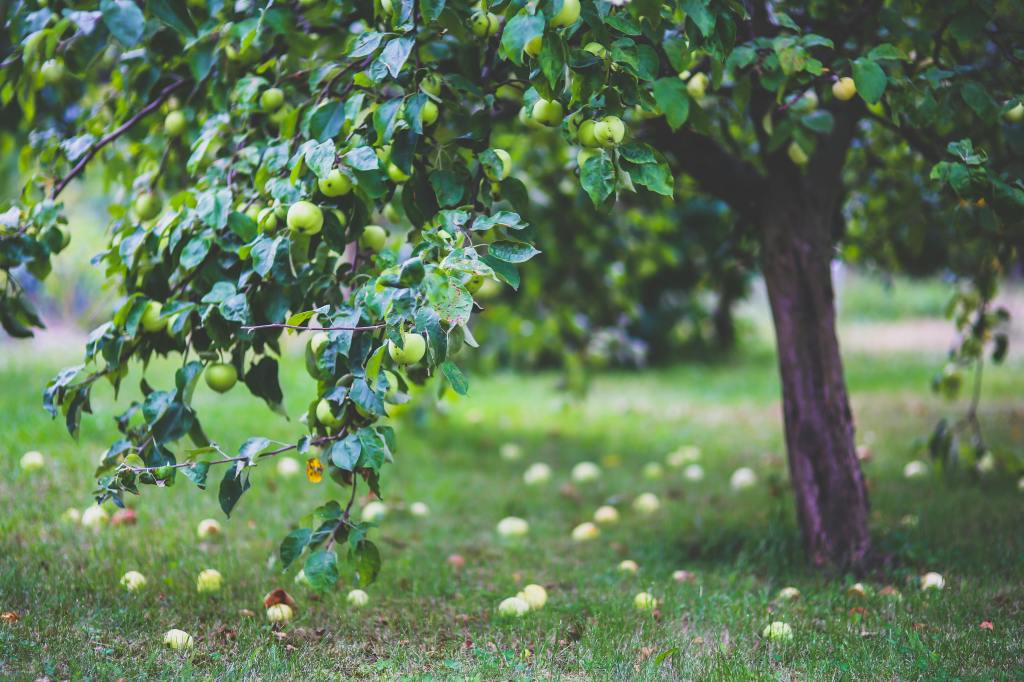
For the greater part of my upbringing, I lived in the Pioneer Valley in Western Massachusetts, a place known for its stunning natural beauty. I literally lived in the middle of the woods. In addition to seeing Bambi’s friends on a daily basis, I spent a lot of time around trees, everything from red maple to gray birch to white oak.
If you wham your hand against a tree, the worst you could probably do is shake down some leaves. Your hand may hurt, too, but the sturdy tree shall remain upright. It’s no surprise then that the word “tree” originates from the reconstructed Proto-Indo-European root *deru- meaning “firm” or “solid.”
Interestingly, *deru- is the same source for the word DURable, which refers to something that can stay strong or “solid” for a long time, just like DURacell batteries (I’m just mentioning their brand to make a point, not because I’m getting paid by them, I promise).
Likewise, enDURance is being able to persevere through difficulties. That’s what Sir Ernest Shackleton and his crew did when their ship – aptly named “Endurance” – got stuck along the Antarctic coastline in January 1915, leaving them stranded for a year and a half on the world’s biggest icy landmass. Eventually, after surviving frigid temperatures, hunting seals for food, and journeying in a flimsy lifeboat on the open ocean for 800 miles, they succeeded in getting all 28 crew members rescued. Epic.
#/media/File:Endurance_Final_Sinking.jpg)
Speaking of maintaining commitment, isn’t that what honesty requires, too? Not giving in to fudging facts or spiraling into denial (however hard that may be) but standing by the truth, like a firmly rooted tree in the face of life’s storms? Believe it or not, as far back as Old English, the words “tree” and “true” have been related to each other! They evolved respectively from trēow (“tree”) and trīewe (“true, faithful, loyal”). It’s no wonder since trees never let us down, providing us with fresh oxygen to breathe every day (can’t say our species is returning the favor very nicely).
By the way, that root *deru- is also where we get the word DRUid, a priest in ancient Celtic cultures. The title is traditionally understood to have meant “one who knows the oak tree,” perhaps a reference to the Druid practice of divination from mistletoe. But some scholars now believe “druid” is best interpreted as “one with firm knowledge.” Either way, the Druids definitely revered trees (especially the oak) as sacred, sentient beings that connected earthly humans to the spiritual realm.

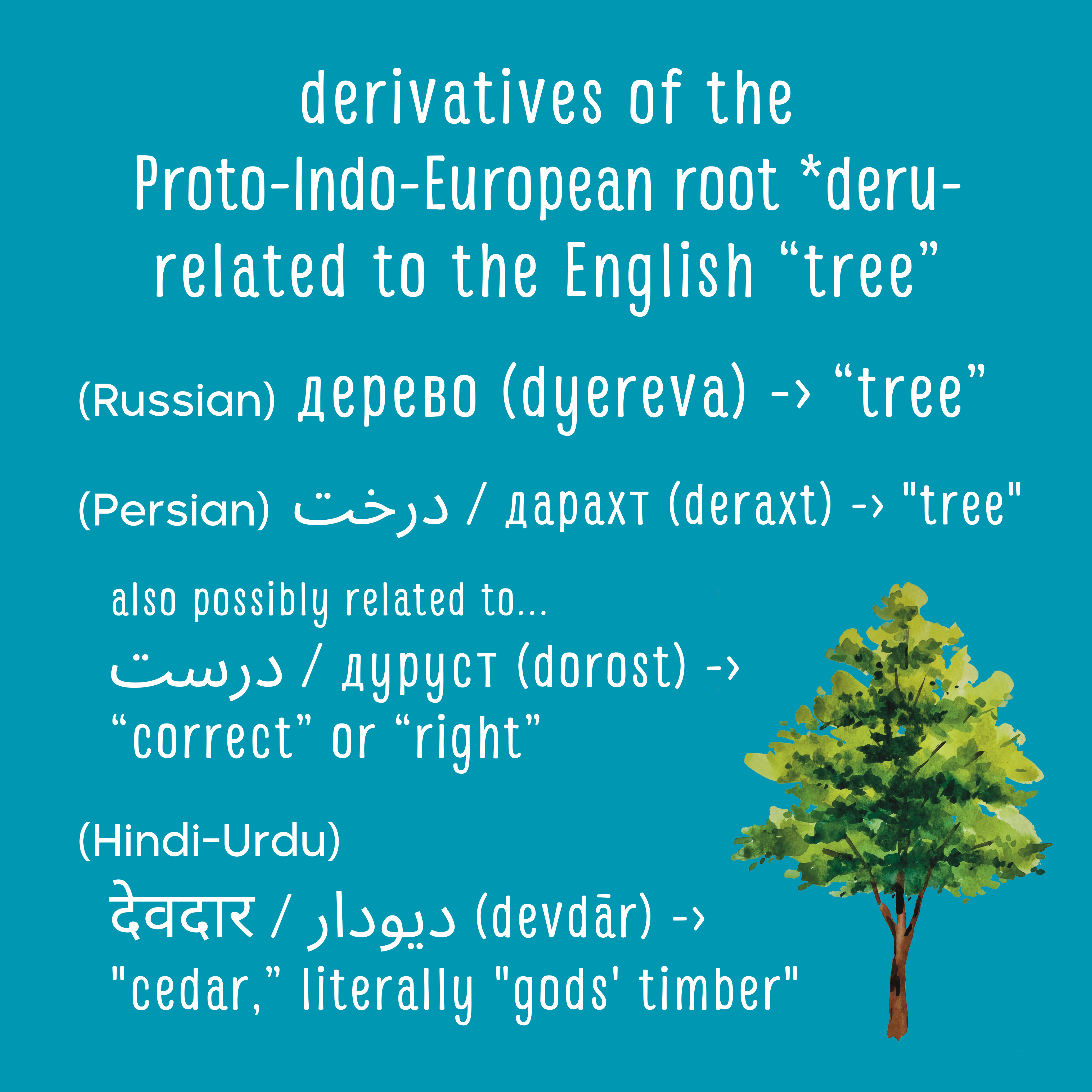
*Fun fact* There are many words in other languages related to the English “tree” via the root *deru-. They include the following:
All this talk of the magnificence of trees reminds me of something my Baba-jan (grandfather) used to say:
“The more fruit a tree bears, the lower it bows down.”

Even in all their might, trees teach us to be humble. As we get older and our knowledge bears fruit, it behooves us to bow our heads in the recognition that we don’t have all the answers. There’s a kind of strength in that. We understand who we are and what our purpose is in life. It’s about being true to ourselves, which makes us more grounded.


 Safarju
Leave a comment